



The Hidden Cost of Foam Cutting Methods in Bulk Road Case Orders

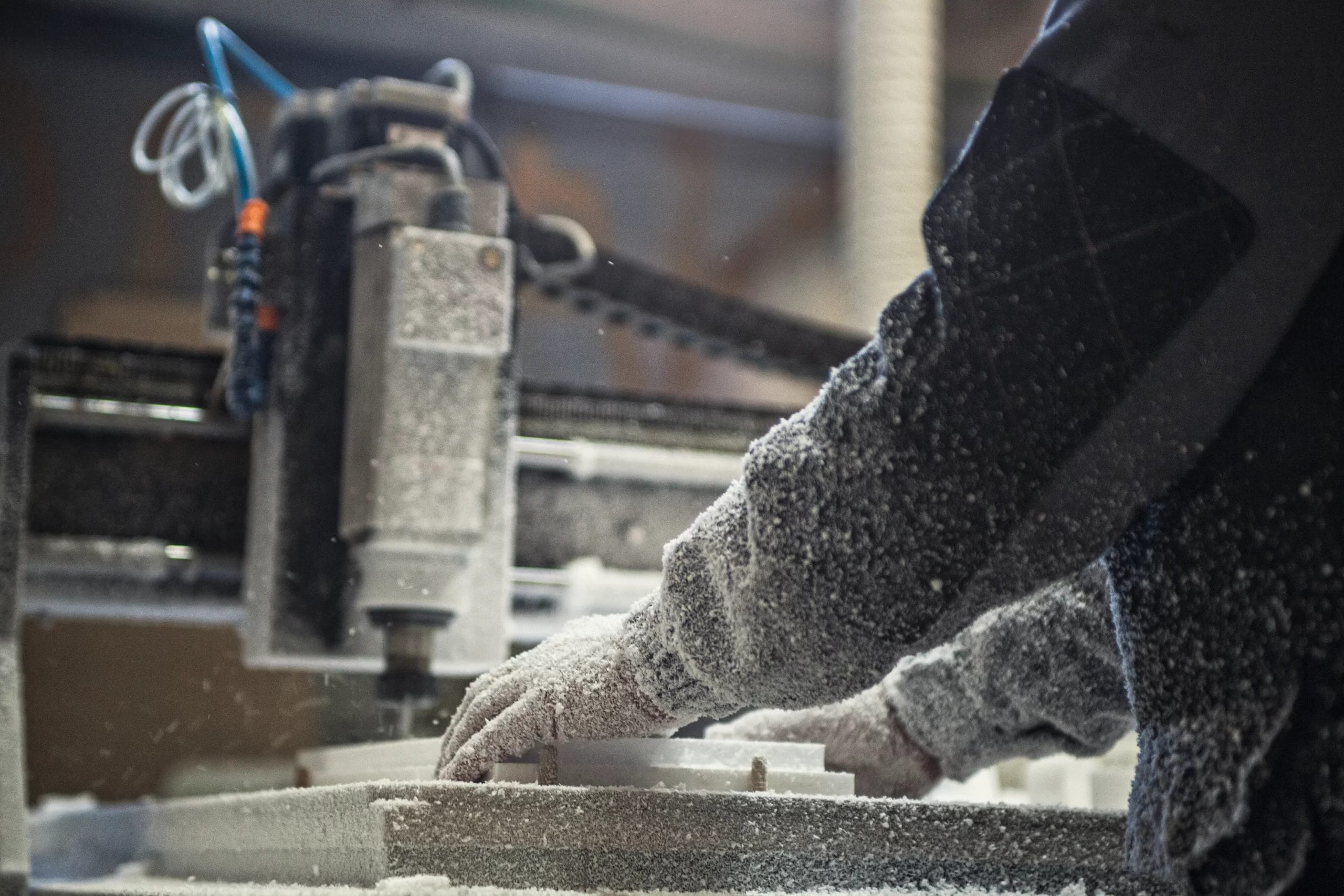
Manual foam cutting creates hidden costs in bulk road case orders. Learn why CNC foam precision affects equipment damage rates and long-term TCO.
Most procurement managers ordering road cases at scale never think to ask about foam cutting methods. The question seems too granular, too far into the weeds of manufacturing details that shouldn't matter as long as the cases look right and the price fits budget.
But six months into a fleet deployment, rental companies start noticing patterns. Equipment returns increase slightly. Foam shows uneven compression in certain cases. A few units from batch three don't quite match the fit quality of batch one. Nothing catastrophic, just enough friction to raise questions.
The root cause often traces back to a single manufacturing decision that most buyers never knew to evaluate how foam interiors were actually cut.
Why Foam Precision Matters More Than Structural Components
In professional road case manufacturing, panels and outer structures get the attention. These are what buyers see first, what photographs well, what's easy to inspect during quality control checks. Most manufacturers at scale use CNC-cut panels because the technology is standard and the benefits are obvious.
Foam operates differently. It's internal, functional, and harder to measure objectively during initial inspection. This creates a blind spot in procurement processes.
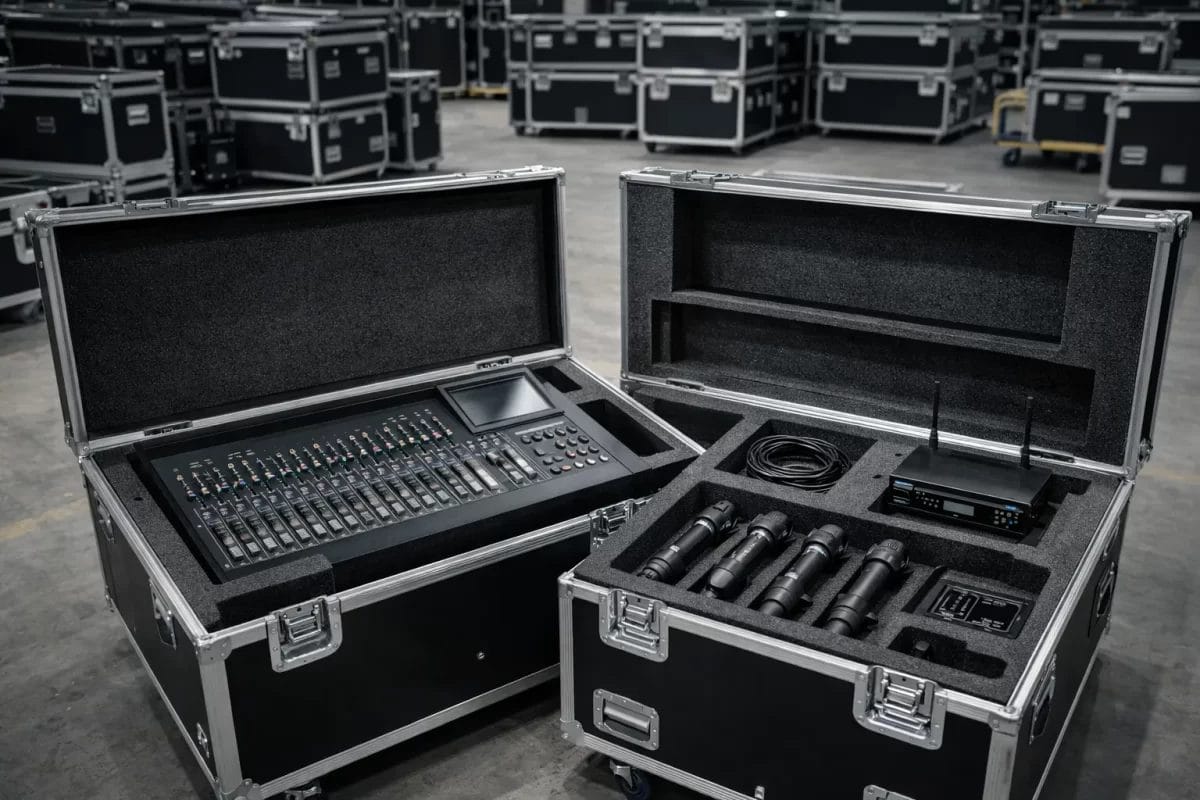
Yet foam serves as the primary load-bearing interface between your equipment and the case structure. It controls positioning accuracy, absorbs shock loads, isolates vibration, and distributes weight during stacking and transport. When foam geometry varies even slightly between cases in a bulk order, these functional properties change in ways that compound over time.
Research on manufacturing variability shows that process inconsistency leads to unpredictable product quality, making it difficult to meet specifications and affecting operational efficiency. In road cases, this manifests as the gradual degradation of protection effectiveness across a fleet.
The Economics of Manual Foam Cutting at Scale
Many road case manufacturers cut panels with CNC precision but switch to manual or semi-manual methods for foam. The economic logic seems sound at first glance. Foam appears simpler to cut than rigid panels. Template-based cutting or hand-guided tools cost less upfront than dedicated CNC foam equipment.
For small production runs or simple rectangular layouts, these methods work adequately. For bulk orders with complex geometries and tight tolerances, they introduce variables that become expensive later.
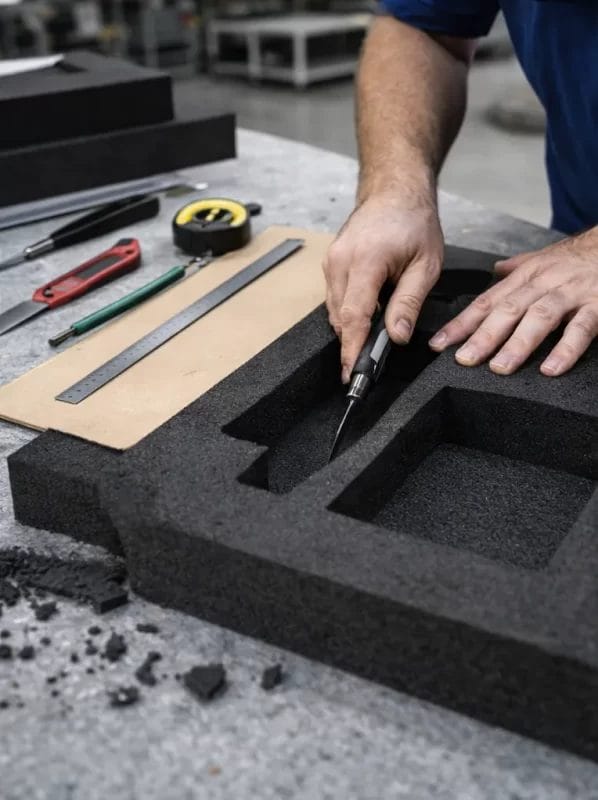
Manual foam cutting relies on operator skill, template accuracy, and visual alignment. Each of these introduces measurement drift. A skilled operator can minimize variance, but cannot eliminate it entirely. Over hundreds of units, these small deviations accumulate into measurable inconsistency.
The cost doesn't appear in the purchase order. It appears in the total cost of ownership over three to five years of fleet operation.
Where Variability Actually Shows Up
Buyers rarely trace operational issues back to foam cutting methods because the connection isn't obvious. The symptoms appear disconnected from the root cause.
Equipment damage rates tick upward slightly. Not enough to trigger immediate investigation, but enough to affect insurance costs and replacement budgets over time. Foam compression becomes uneven across cases that should be identical. Some units in a touring fleet develop movement issues while others remain stable. Reorders placed months after the initial batch don't quite match the original specifications, even when ordering from the same manufacturer.
These issues share a common origin: geometric variance in foam cutting that falls within acceptable tolerances for individual cases but creates problems when scaled across hundreds of units in active service.
Studies on manufacturing defects indicate that dimensional inaccuracies account for a significant portion of quality failures, with costs ranging from 15% to 20% of revenue for companies with poor quality systems. For bulk road case buyers, this translates directly into higher equipment replacement costs and increased damage claims.
CNC Foam Cutting: What Changes at the Process Level
Full CNC integration for foam cutting changes the manufacturing equation fundamentally.
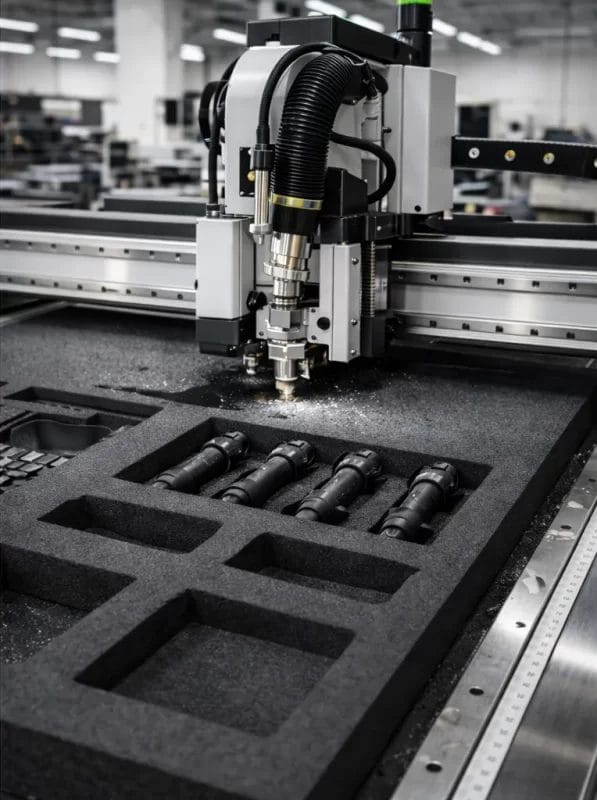
Instead of operators interpreting templates and making measurement decisions, digital CAD data drives cutting machinery directly. Every foam profile is cut from the same source file with repeatable precision. Depth control, edge geometry, and complex contours reproduce identically across production runs.
This eliminates the human interpretation layer where variance enters traditional foam cutting processes. An operator running a CNC foam cutter executes a digital instruction set rather than making real-time cutting decisions. The machine maintains tolerances that manual methods cannot match consistently.
For bulk buyers, this translates into a predictable outcome: case 247 fits equipment with the same precision as case 1. Six months later, reorder batch 2 matches the original specifications without manual recalibration or template verification.
The True Cost Comparison
Manufacturers using manual foam cutting methods can often quote lower initial prices. The cost structure appears favorable when evaluating bids on a per-unit basis.
But procurement decisions made solely on acquisition cost miss the total economic picture. The relevant comparison isn't unit price—it's total cost of ownership across the operational lifespan of your road case fleet.
Equipment protected by cases with inconsistent foam geometry experiences higher damage rates. Industry data suggests that companies with robust quality management systems achieve on-time delivery rates above 95% and customer retention exceeding 30%, while those with poor systems face significantly higher costs due to rework and returns.
For a touring company operating 200 road cases over five years, even a 2% to 3% increase in equipment damage rates can offset any savings from lower initial case prices. Add in the cost of handling returns, managing inconsistent inventory, and dealing with cases that don't quite fit properly, and the economics shift decisively.
What This Means for Specification Development
Most road case RFPs focus on structural specifications, hardware quality, and material standards. These matter, but they're also the areas where most manufacturers at scale already perform adequately.
The specification gap exists in manufacturing process requirements. Buyers who want predictable outcomes across large orders should ask different questions than those focused solely on individual case quality.
How is foam cut? What machinery is used? Are all components, including foam, driven by digital CAD data? How are tolerances verified and documented across production batches? What happens to geometric accuracy when reorders occur months or years after initial production?
Manufacturers operating fully CNC-driven workflows can answer these questions with process documentation. Those relying on manual foam methods typically respond with assurances about operator skill and template accuracy—which aren't scalable quality controls.
Research shows 56% of buyers won't work with providers whose thought leadership is poor, and 73% wouldn't recommend them to colleagues. This extends to manufacturing partnerships where process transparency determines long-term reliability.
Engineering Integration as a Purchasing Criterion
The manufacturers who deliver consistent results at scale don't treat foam cutting as a separate operation from panel machining. They integrate it into a unified CAD-to-CNC workflow where every component exists within the same digital system.
This integration provides benefits beyond geometric accuracy. Design changes propagate cleanly across all components. Revisions don't require new templates or operator retraining. Quality documentation ties directly to digital source files rather than physical templates that can degrade over time.
For international buyers sourcing from China, this level of process integration serves as a reliable indicator of manufacturing maturity. The technology itself isn't rare—CNC foam cutting equipment is widely available. What separates premium suppliers from commodity manufacturers is the discipline to integrate it fully rather than applying it selectively to reduce costs.
Making Foam Precision a Procurement Priority
The challenge for bulk buyers is that foam cutting methods aren't visible in samples or initial prototype approvals. A well-executed manual foam cut can look identical to a CNC-cut foam interior when you're evaluating a single case.
The difference emerges across hundreds of units and multiple production batches. By the time inconsistency becomes apparent, switching suppliers involves significant cost and operational disruption.
This makes foam cutting methodology a front-end procurement criterion rather than something to verify during production. The question belongs in initial supplier evaluation, not in post-production quality control.
Buyers who integrate foam precision into their supplier assessment criteria gain a significant advantage: they avoid the hidden costs that appear 12 to 18 months into fleet operation when manual cutting variance accumulates into measurable performance degradation.
The Total Cost of Ownership Perspective
Smart procurement teams evaluate road case suppliers on total cost of ownership, not acquisition price alone. This requires accounting for costs that occur throughout the operational lifespan of the case fleet.
Equipment damage and replacement costs. Returns and rework expenses. Inventory management complexity from inconsistent case quality. The operational overhead of managing cases that don't quite fit properly. Reorder challenges when geometric accuracy drifts between production runs.
When these factors enter the economic analysis, the cost premium for CNC-driven foam cutting often disappears entirely. The manufacturers who can deliver true batch consistency through process integration typically offer better total economics than those competing on initial unit price.
Manufacturing quality research indicates that companies investing in precision processes reduce defect-related costs significantly, often recovering the investment through lower warranty claims and higher customer retention rates.
What Armor Cases Brings to This Challenge
At Armor Cases, we recognized this procurement challenge years ago when working with touring companies and rental operations placing large fleet orders. The pattern was consistent: buyers focused on structural quality and missed the manufacturing process details that determined long-term performance.
Our solution was to eliminate the manual foam cutting variable entirely. Every component in our cases, including all foam interiors, is cut using CNC machinery driven directly from 3D CAD data. No templates, no manual measurement, no operator-dependent tolerances.
This isn't about having better operators or more careful quality control. It's about removing human interpretation from the cutting process so that geometric accuracy becomes a systems outcome rather than a skill-dependent variable.
For bulk buyers, this translates directly into the outcome they actually need: predictable consistency across every unit in every batch, with the ability to reorder confidently months or years later knowing the specifications will match exactly.
Final Perspective: Hidden Costs Aren't Hidden Forever
The foam cutting question seems minor when you're evaluating road case suppliers. It's technical, it's internal, and it doesn't photograph well in product catalogs.
But for buyers placing container-level orders or building long-term fleet inventories, foam cutting methodology directly affects total cost of ownership. The savings from choosing manual foam cutting methods show up immediately in lower acquisition costs. The costs show up later in equipment damage rates, inconsistent fleet performance, and the operational complexity of managing cases that should be identical but aren't.
Smart procurement teams ask about foam cutting methods upfront, making it a qualification criterion rather than an afterthought. Because by the time foam variance becomes visible in operational data, switching suppliers costs more than paying for CNC precision from the beginning.
Foam precision represents just one dimension of supplier quality assessment. For a comprehensive framework covering process documentation, tolerance control, and long-term reliability indicators, explore our guide on choosing a flight case manufacturing partner in China. Understanding how CNC integration fits within broader procurement criteria helps operations teams make decisions that protect both equipment and budgets across multi-year fleet deployment.