



How to Choose a Flight Case Manufacturer in China | Armor Cases

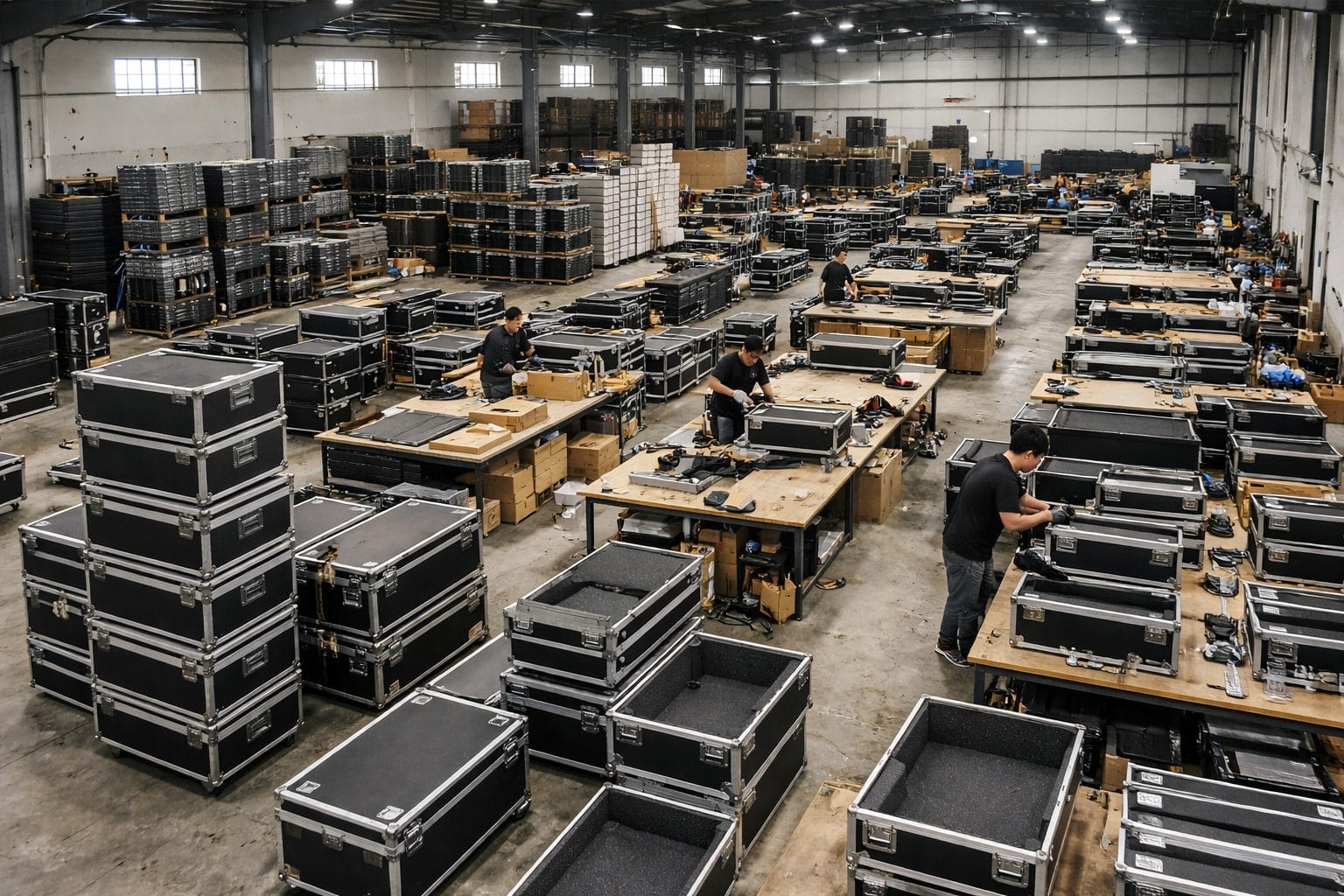
Sourcing flight cases from China at scale is not the same as placing a small sample order. Any factory can ship a presentable prototype. The real test is whether that factory can reproduce the same product accurately, reliably, and consistently across hundreds of units, multiple production runs, and changing order sizes.
For production companies, AV distributors, equipment rental businesses, and tour operators placing bulk road case orders, the difference between a trustworthy Chinese flight case manufacturer and an unreliable one isn't visible in a product photo or a first sample. It shows up in the third order. In the sixth shipment. When your foam inserts start arriving loose. When lid tolerances drift by 3mm. When the hardware that looked solid on the prototype starts failing after six months of touring.
This guide gives you a practical 7-point checklist to evaluate any flight case manufacturer in China before you commit to a volume order built on the same standards Armor Cases applies to our own Guangzhou manufacturing facility, designed by our Sydney engineering team.
Table of Contents
Why Bulk Orders Require a Different Evaluation Standard
Most sourcing problems with Chinese flight case manufacturers don't appear in the first order. They accumulate.
When a buyer places an initial order of 20–30 units, factories often treat it as a high-attention pilot run. Senior staff are involved. Quality checks are more careful. The prototype approval was recent, so the specs are fresh in everyone's minds.
By the third or fourth reorder or when quantities jump to 100+ units conditions change. Production is delegated. Material batches rotate. Minor tolerances drift informally. And unless the manufacturer has systems in place to lock these variables down, product quality begins to drift with them.
This is why evaluating a bulk road case manufacturer requires a different lens than evaluating a one-off supplier. You're not asking "can they make a good case?" You're asking "can they make the same good case, every time, for the next three years?"
The 7 points below are the questions that answer that.
Design Control and CAD Engineering Ownership
The single most overlooked factor when choosing a custom road case manufacturer in China is who actually controls the design files. Many factories can manufacture from drawings, but far fewer maintain a structured system to manage those drawings as living documents with version control, revision history, and a defined approval process between reorders.
Without proper design control, internal foam dimensions shift as workers interpret specs differently, structural panel thickness gets substituted quietly when a supplier changes their stock, and hardware placement drifts across production runs. Ask any prospective supplier whether they use professional 3D CAD software such as SolidWorks, who owns the models after delivery, and how design changes are documented and approved. A factory working from 2D sketches or PDFs with no formal CAD infrastructure represents a serious long-term consistency risk.

CNC Precision and Manufacturing Repeatability
Producing one flight case well requires skill. Producing 500 identical units requires systems. Human cutting introduces dimensional variability of 1–4mm across panels at scale, this produces fitment problems, lid gap inconsistencies, and foam misalignment that compound across every unit in a run. CNC routers hold tolerances of ±0.5mm regardless of the operator or the production stage, and jig-based assembly standardises hardware positioning consistently.
When auditing a potential road case supplier in China, ask whether panels are CNC cut or hand cut, whether assembly jigs are used, and what their stated dimensional tolerance is. A factory relying primarily on manual methods will struggle to maintain consistency on large or repeat orders regardless of how good the first shipment looks.

Materials Transparency
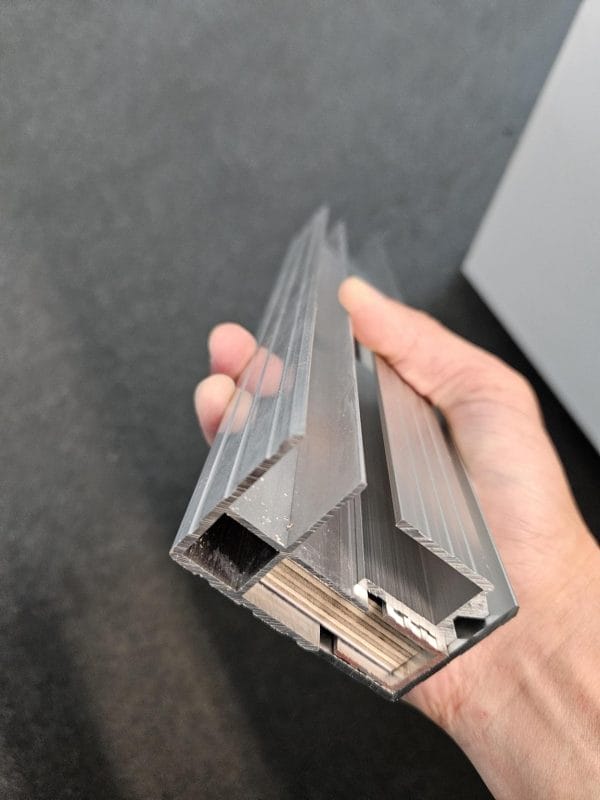
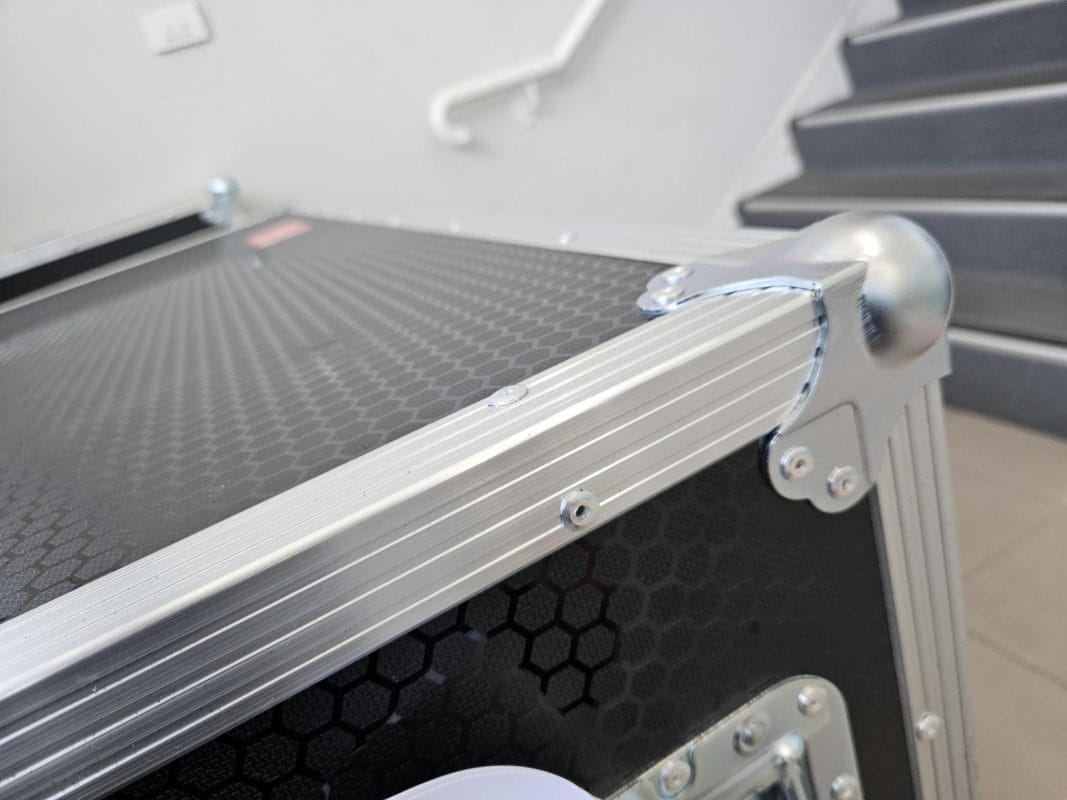
Price differences between Chinese flight case suppliers almost always trace back to material substitutions invisible from the outside. Professional road cases use hardwood-core or Baltic birch plywood for structural integrity. Budget manufacturers often substitute softwood ply or MDF, which delaminate under touring stress. Exterior ABS laminate below 3mm compromises long-term durability. Foam density matters enormously low-density foam compresses and loses its protective qualities within two to three years, while quality applications require closed-cell foam at 45–80 kg/m³. Aluminium extrusions should be anodised to resist corrosion in humid environments.
Any reputable OEM flight case manufacturer should provide specific material data ply grade, laminate thickness, foam density in kg/m³. If they cannot, that tells you everything.
Quality Control Process and Documentation
A factory's QC process is more revealing than their product samples. Ask about three stages: pre-production sign-off (are drawings and materials formally approved before cutting begins?), in-process inspection (at what intervals and by whom?), and pre-shipment review (how many units are inspected per batch and is a report provided?).
For container-level orders, the most effective protection a buyer has is a third-party pre-shipment inspection through SGS or Bureau Veritas. A factory that resists this access is a serious caution sign. Equally revealing is whether they track defect rates over time. A manufacturer with no defect data either doesn't measure it or doesn't want to share it.
Foam Cutting Technology
For cases built around specific equipment consoles, cameras, medical devices, scientific instruments — the foam insert delivers most of the protection value, and foam quality varies more widely than almost any other variable across Chinese manufacturers. Manual knife cutting introduces variability of 3–8mm and cannot achieve clean internal contours for complex geometries. CNC foam cutting holds ±1mm tolerances and can reproduce precise equipment profiles from digital models. The highest-level capability is 3D laser scanning, where actual equipment geometry is captured and the foam cavity is generated directly from that data, eliminating measurement error entirely. Ask whether foam is CNC cut, what tolerance is held, and whether the factory supports equipment scanning for custom-profile inserts.
Hardware Sourcing
Hardware is where touring road cases fail most visibly. Butterfly latches, lid stays, handles, and casters are under constant mechanical stress, and the quality gap between branded and generic components becomes apparent quickly. The benchmark for professional road case hardware is Penn Elcom, whose components are specified by top touring operations worldwide. Generic, unbranded hardware typically performs adequately for 6–18 months before fatigue failure begins a false economy for cases loaded and unloaded hundreds of times per year. A manufacturer who cannot name the brand or load rating of their hardware is telling you something important about how they source everything else.
Communication and After-Sales Support
This is the least technical point but often the one that determines whether a manufacturing relationship lasts. Ask whether there is a dedicated project contact or just a generic sales inbox, how quickly technical questions are answered, and whether production updates are proactive or only shared when the buyer chases. A supplier who is difficult to reach before the purchase order is placed will be harder to reach when something goes wrong. After-sales reliability warranty handling, replacement components, reorder consistency is part of the product. It should be evaluated as seriously as the case itself.
How Armor Cases Is Built Around These Standards
Armor Cases was founded in Sydney, Australia in 2016 to solve exactly the problem this checklist describes: combining Western engineering rigour with Chinese manufacturing scale, without compromising either.
Our Sydney team designs every case in SolidWorks with version-controlled files owned by Armor Cases. Our Guangzhou facility uses CNC routers for panel cutting to ±0.5mm, CNC machines for foam shaping, and assembly jigs throughout. We use hardwood-core birch plywood, 3mm+ ABS laminate, and closed-cell foam at specified densities — with material data sheets available on request. Penn Elcom hardware is standard across our touring-grade range. Every bulk order includes a pre-shipment inspection with photographic documentation, with third-party SGS access available for large orders. And every order is managed by a dedicated Sydney project contact with real engineering knowledge not a sales script.
Our manufacturing workflow overview and total cost of ownership analysis cover the full picture.
Frequently Asked Questions
What should I look for in a flight case manufacturer in China?
The seven most important factors are CAD-based design control, CNC manufacturing capability, materials transparency, a documented QC process, precision foam cutting, branded hardware, and reliable after-sales communication. A manufacturer who provides specific, documented answers on all seven is a strong candidate for a long-term bulk supply relationship.
How do I verify quality before placing a large order from China?
Request a pre-production sample tied to an approved CAD drawing and inspect it against a written specification checklist.
Does Armor Cases manufacture in China?
Yes. Products are designed in Sydney using SolidWorks and manufactured at our dedicated Guangzhou facility delivering premium quality at competitive bulk pricing with Australian engineering standards throughout. Read more about our Sydney-to-Guangzhou workflow here.
What is the minimum order quantity at Armor Cases?
We work with buyers from 10 units upward for standard configurations. Contact our team to discuss your requirements.
If you are evaluating flight case manufacturers in China and want a supplier who answers every point on this checklist with data not generalities request a bulk quote from Armor Cases or explore our full custom road case range.